Additive Manufacturing · Metallic Materials
LPBF Ti–Ta Alloys
Investigating processing–microstructure–property relationships in Ti–Ta alloys manufactured through mechanical alloying and laser powder bed fusion.
Project Overview
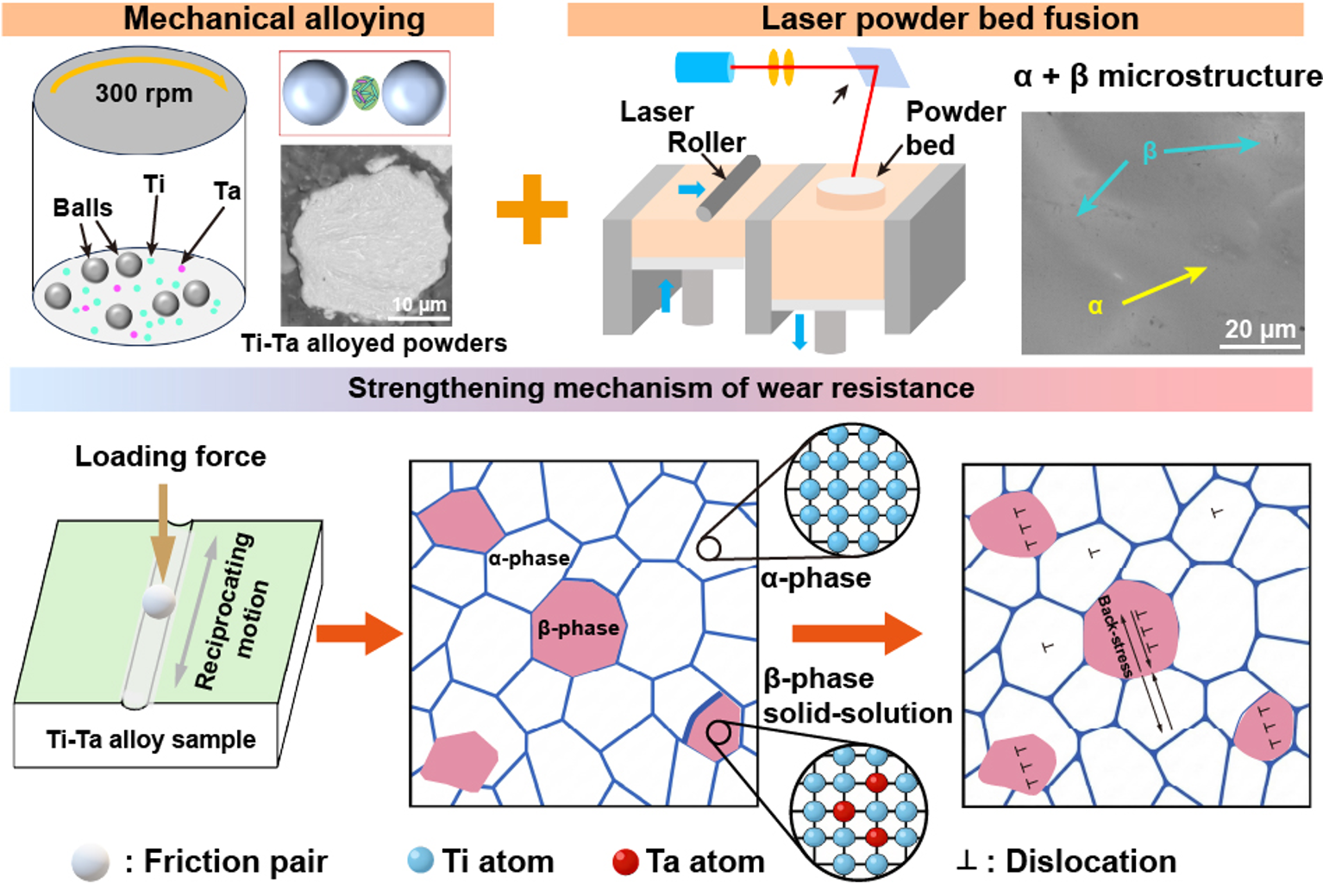
This project investigated how mechanical alloying and LPBF processing influence phase formation, microstructure, elastic modulus, and wear behavior in Ti–Ta alloys.
Role
First-author Research
Publication
Advanced Engineering Materials
Main Methods
Mechanical Alloying · LPBF · XRD · SEM · EBSD · Tribological Testing
Research Logic
Processing → Microstructure → Mechanical Properties
Manufacturing Route
Mechanical Alloying
+
Laser Powder Bed Fusion
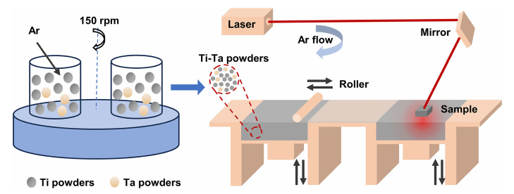
Mechanical alloying was used to promote Ti–Ta mixing and solid-solution formation. LPBF then introduced rapid melting and solidification, enabling the formation and retention of the α + β dual-phase microstructure.
My Contribution
From fabrication
to scientific
communication
I participated across the full experimental workflow, including powder processing, LPBF fabrication, characterization, mechanical testing, data analysis, and manuscript preparation.
Powder preparation and mechanical alloying
Prepared Ti–Ta powders and controlled mechanical alloying conditions for subsequent LPBF processing.
LPBF sample fabrication
Participated in the fabrication of Ti–Ta specimens using laser powder bed fusion.
XRD, SEM, and EBSD characterization
Investigated phase composition, microstructure, crystallographic orientation, and local deformation behavior.
Wear and mechanical testing
Evaluated tribological behavior, hardness, elastic modulus, and related mechanical properties.
Experimental data analysis
Processed and interpreted experimental results to establish processing–microstructure–property relationships.
Figure preparation and manuscript drafting
Prepared scientific figures and contributed to the writing, organization, and revision of the manuscript.
Key Results
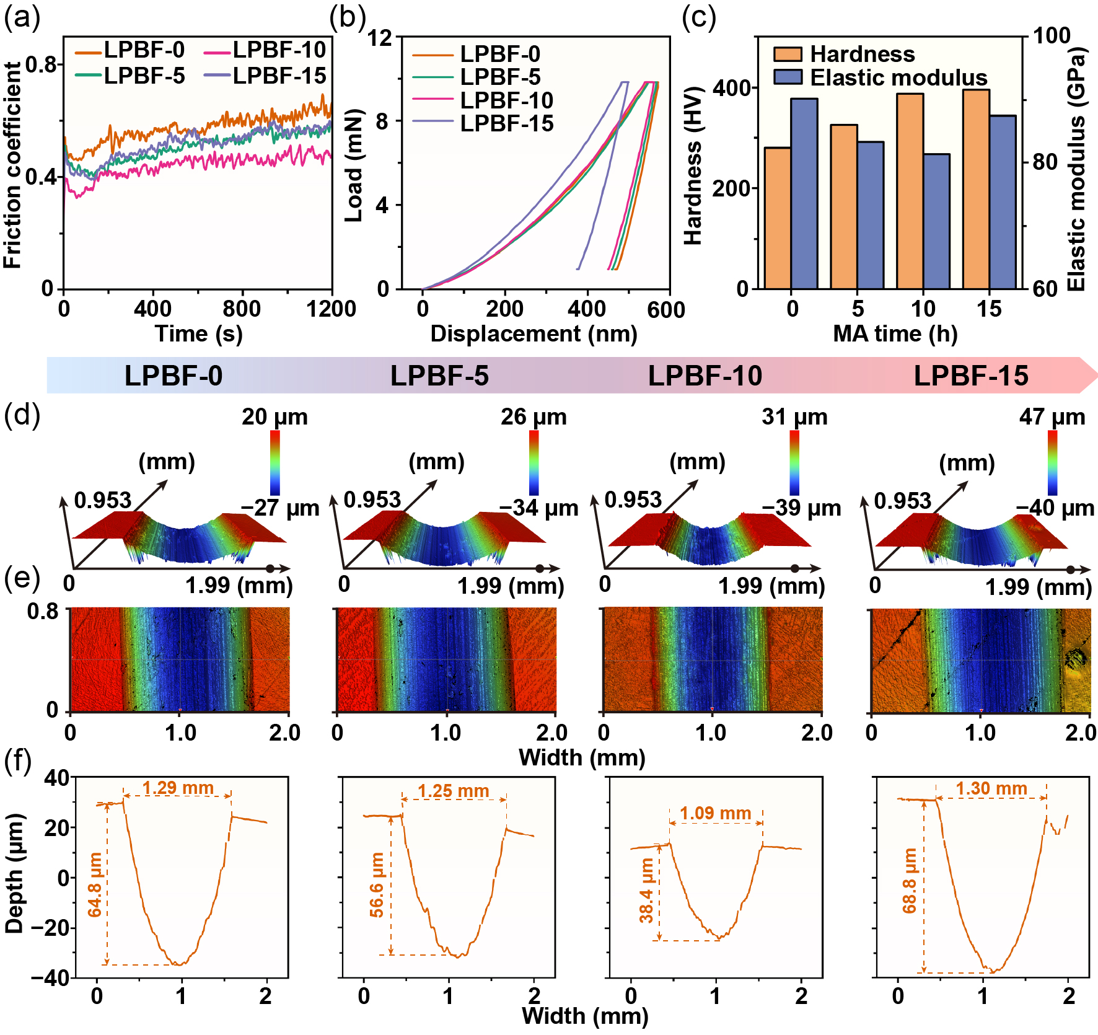
Improved wear resistance with a relatively low elastic modulus
Coefficient of Friction
≈ 0.46
Wear Rate
1.35 × 10⁻³
mm³·N⁻¹·m⁻¹
Elastic Modulus
81.4 GPa
Key Observation
The optimized alloy combines improved wear resistance with a relatively low elastic modulus. Its wear resistance is associated with the stable fine-grained structure, β-phase solid solution, and dislocation-induced back-stress strengthening during friction.
Strengthening Mechanism
Fine grains and β-phase solid solution synergistically enhance wear resistance

Stable Fine-Grained Structure
A fine-grained microstructure of approximately 0.56 μm was retained after friction, indicating good microstructural stability and providing high resistance to shear deformation.
Dislocation Storage in β Phase
During friction, stress-induced dislocations preferentially accumulated within the dispersed β-phase solid solution, demonstrating its strong ability to accommodate plastic deformation.
Back-Stress Strengthening
Continued dislocation accumulation promotes dislocation walls and back stress near α/β phase boundaries. This long-range internal stress counteracts part of the applied shear stress during friction.
Mechanism Summary
Enhanced wear resistance results from the synergistic effects of grain-refinement strengthening and β-phase solid-solution strengthening, together with dislocation accumulation and back-stress development during friction.
What I Learned
Key insights gained from the design, fabrication, characterization, and interpretation of this project.
This work strengthened my understanding of how fabrication, microstructure, and mechanical behavior can be systematically connected.
More importantly, it helped me move beyond simply measuring material properties toward understanding how processing choices can be deliberately used to engineer structure and function.
Processing matters
Mechanical alloying and LPBF conditions directly influence phase formation and microstructural evolution.
Structure explains performance
Grain refinement, β-phase retention, and dislocation behavior provide a mechanistic explanation for the observed properties.
Toward functional structures
This processing–structure–property perspective now supports my interest in functional, responsive, and adaptive mechanical systems.